





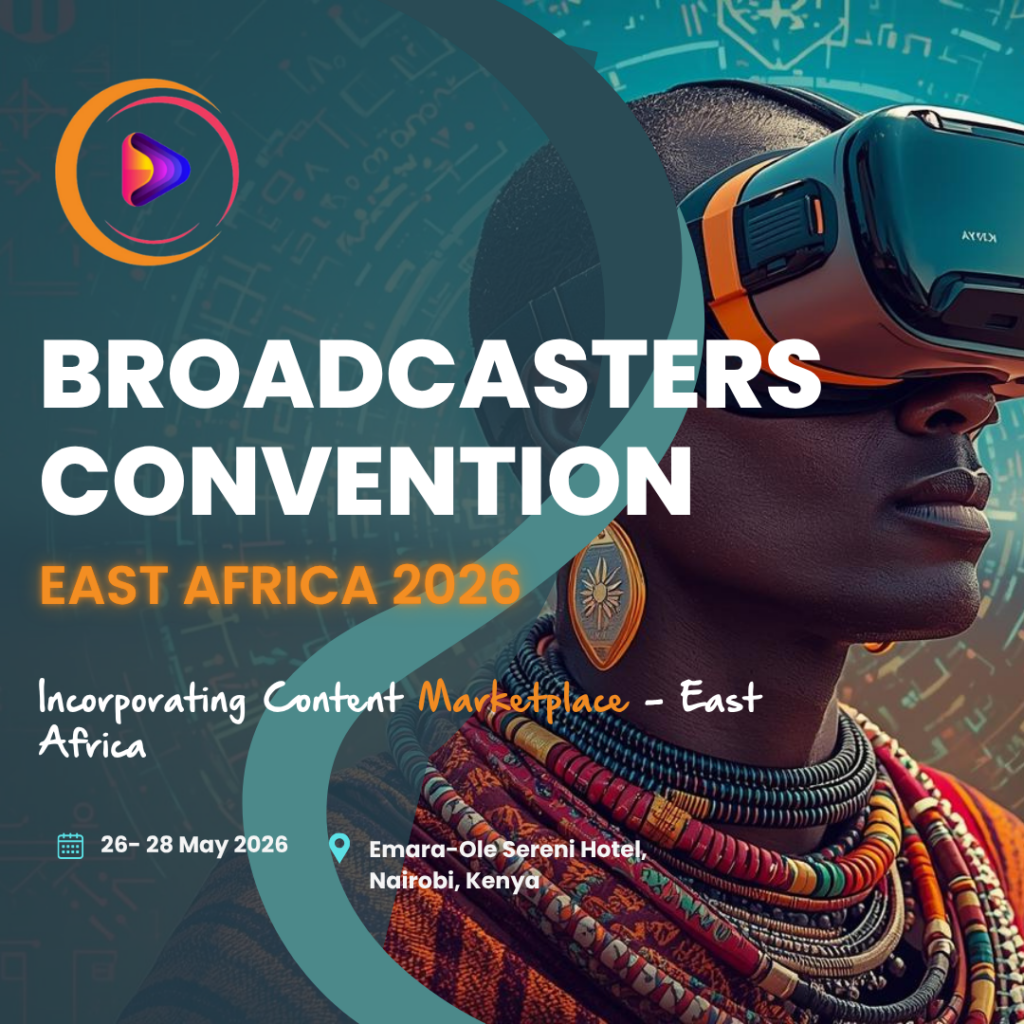
This article is written by Benjamin Pius (Publisher @ BMA) as part of the forthcoming Broadcasters Convention – East Africa, 26–28 May 2026, Nairobi, Kenya. Register and view the full programme →
Africa’s broadcasters no longer compete only with each other. They now compete with a satellite dish on the roof, a streaming app on a smart TV, and a mobile phone in every pocket — all chasing the same viewer at the same time.
As audiences fragment across free-to-air, pay-TV, and on-demand platforms, a new question now sits at the centre of every boardroom conversation on the continent — how should content reach the viewer, and through how many pipes at once?
In this article, I examine the dominant distribution paths open to African broadcasters today — and why the future belongs to those willing to combine them deliberately rather than defend any single one.
LINEAR / FREE-TO-AIR
Linear broadcasting remains the backbone of African television. Free-to-air delivers the widest possible reach at the lowest marginal cost to the viewer, and in most sub-Saharan markets it still commands the majority of household viewing time. For advertisers seeking scale and simultaneity, nothing yet rivals it.
But linear economics are under strain. Advertising revenues are flat or declining in many markets, younger audiences are migrating to on-demand platforms, and the fixed schedule that once disciplined viewing now feels like a constraint. Free-to-air alone cannot deliver the personalisation, measurement, or premium pricing that modern content economics demand.
PAY-TV AND SATELLITE
Direct-to-home satellite — long shaped by MultiChoice, Canal+, StarTimes, and Azam — solved two problems at once: it bypassed patchy terrestrial infrastructure and built subscription revenue at scale. Pay-TV still delivers the continent’s richest mix of sport, international channels, and premium local drama. The Canal+ takeover of MultiChoice, finalised in late 2025, has created a combined group serving more than 40 million subscribers across seventy-odd countries.
Its vulnerabilities, however, are now unmistakable. MultiChoice alone shed roughly half a million subscribers in its most recent reporting year, as currency volatility, rising content costs, and cheaper streaming alternatives compressed margins. Cord-cutting has arrived in African cities, even if it moves more slowly than in the West. Pay-TV operators that treat the satellite dish as the product — rather than as one distribution surface among many — will find the ground shifting beneath them.
STREAMING AND OTT
Over-the-top (OTT) streaming delivers the personalisation, portability, and data feedback loops that linear and DTH cannot. Showmax (now part of the Canal+ stable) operates in 44 African countries, Netflix is investing in African originals, and YouTube has quietly become the continent’s largest shopfront for local content. Africa now hosts hundreds of streaming services, according to recent industry counts by Broadcast Media Africa (BMA) Industry Data and Intelligence service, with FAST — free ad-supported streaming television — the fastest-growing category.
Yet OTT streaming in Africa faces significant constraints. Data costs remain punitive for mass audiences, card payment friction limits subscription conversion, and smart TV penetration lags far behind mobile. A pure streaming strategy reaches the urban middle class comfortably — and very little beyond it. Churn is high, and the unit economics of standalone streaming services have proven difficult even for global majors.
THE HYBRID IMPERATIVE
The winning model is not a choice between these three — it is a deliberate layering of all of them. A hybrid broadcaster runs a free-to-air channel to guarantee reach, a pay-tier (owned or partnered) to monetise premium rights, and an on-demand platform to capture audience data, extend content windows, and retain younger viewers. FAST channels repurpose library content at almost zero marginal cost. Telco partnerships, mobile-money payment rails, and ad-supported tiers close the affordability gap that pure SVOD cannot bridge.
This is no longer a theoretical strategy. The combined DTH-plus-Showmax play at MultiChoice (now part of Canal+), the proliferation of broadcaster-owned streaming apps across Nigeria, Kenya, and South Africa, and the steady march of telco-distributed video bundles all point in the same direction: distribution is becoming portfolio management.
The broadcasters that will shape Africa’s next decade are those that stop defending a single pipe and start orchestrating many. Betting on satellite alone, terrestrial alone, or streaming alone is no longer a distribution strategy. It is a wager on yesterday’s audience.
This article is written by Benjamin Pius (Publisher @ BMA) as part of the forthcoming Broadcasters Convention – East Africa, 26–28 May 2026, Nairobi, Kenya. Register and view the full programme →