







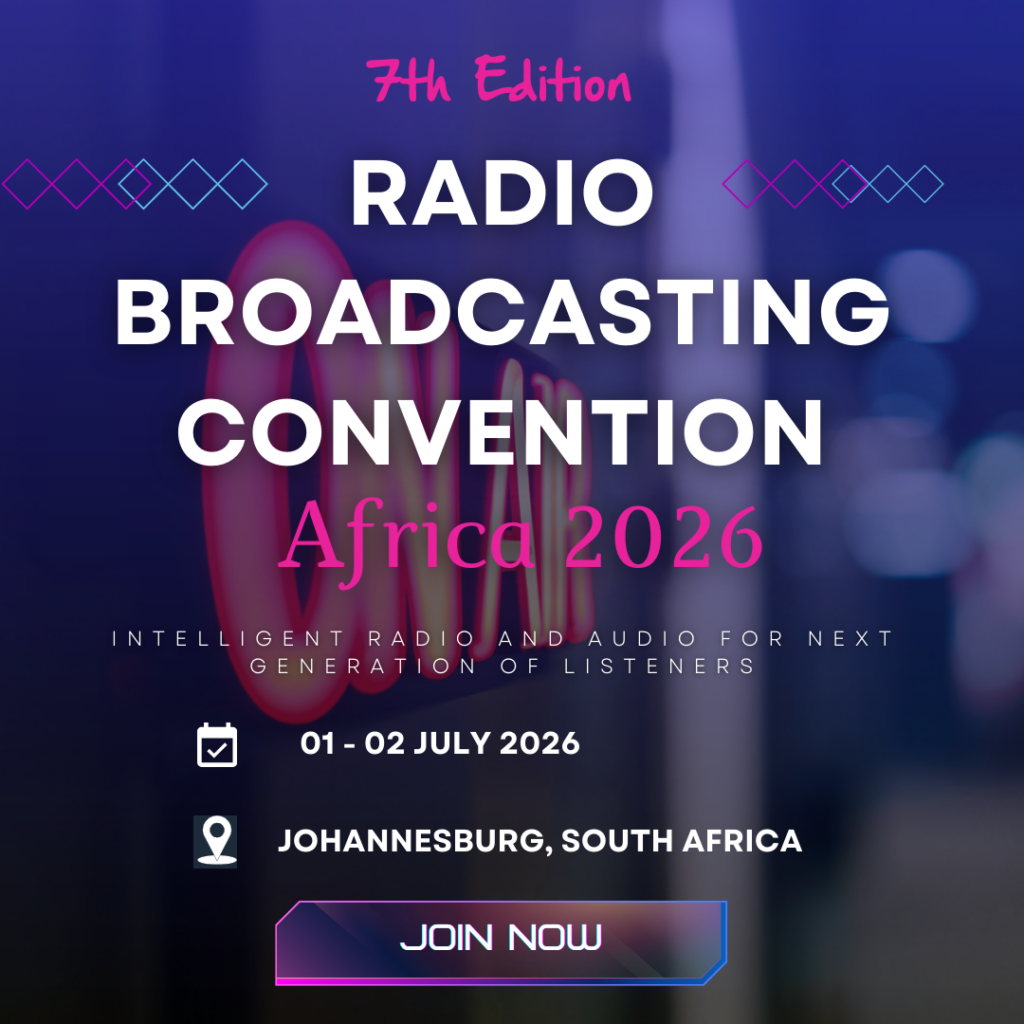
The evolving relationship between journalism, audience engagement and digital media took centre stage on the opening day of the 7th Radio Broadcasting Convention – Africa 2026, on 01 July 2026, at The Venue, Green Park, Johannesburg, as leading broadcasters and media executives from across the continent gathered to debate whether the rise of infotainment represents the evolution—or degradation—of news broadcasting.
Convened by Broadcast Media Africa (BMA), the first day of the convention brought together industry leaders, regulators, technology providers and media professionals to examine the opportunities and challenges shaping the future of African radio.
One of the day’s standout sessions, “Infotainment in Media: News Format – Evolution or Degradation?”, explored how broadcasters are adapting news formats to changing audience behaviours while preserving the credibility and public trust that have long defined radio journalism.
Moderated by Olga Lisogor, Head of International News Agency and Radio at Sputnik, the discussion examined the growing pressure on broadcasters to make news more engaging without compromising editorial standards.
“The challenge is no longer simply delivering the news—it’s delivering it in ways that audiences choose to consume while maintaining accuracy, credibility and public trust,” said Lisogor. “The future belongs to broadcasters who can successfully balance information with meaningful audience engagement.”
Davies Kabuswe, Executive President of Sun Broadcasting Holdings, argued that infotainment has become an essential component of modern broadcasting rather than a departure from journalism.
“Audiences have changed dramatically. If broadcasters fail to evolve their storytelling and presentation, they risk becoming irrelevant. Infotainment, when executed responsibly, is not the enemy of journalism—it is a powerful vehicle for extending its reach and impact.”
Representing Zimpapers Broadcasting, Comfort Mbofana, General Manager for Radio & TV, emphasised that audience growth should never come at the expense of editorial integrity.
“Radio continues to be one of Africa’s most trusted media platforms because audiences believe in its credibility. Innovation must enhance journalism, not replace it. Our responsibility is to inform while embracing formats that resonate with today’s audiences.”
Offering perspectives from both traditional broadcasting and digital media, Gerda de Sousa, Podcaster and Newscast Editor at Jacaranda FM, highlighted the importance of understanding changing listener habits.
“Today’s audiences consume content across multiple platforms and expect authenticity, relevance and immediacy. Radio’s greatest strength is its ability to build human connection. The opportunity lies in combining trusted journalism with compelling storytelling that meets audiences wherever they are.”
Opening the convention, Mr Benjamin Pius, CEO of Broadcast Media Africa, said the conversations taking place during the event reflect an industry committed to innovation while remaining true to radio’s core purpose.
“Radio has consistently demonstrated its resilience by adapting to every technological shift. What we are witnessing today is another important chapter in that evolution. The discussions here are about ensuring African radio continues to lead through innovation, trusted journalism and meaningful audience engagement.”
Beyond the keynote panel, delegates participated in a series of sessions examining digital transformation, artificial intelligence, audience measurement, content innovation, monetisation strategies and the changing economics of radio broadcasting.
A recurring message throughout the day was that while platforms and technologies continue to evolve, trust remains radio’s greatest competitive advantage. Speakers agreed that future success will depend on combining credible journalism with innovative content strategies, data-driven decision-making and deeper audience engagement.
The convention continues on 02 July 2026, with further discussions focusing on emerging technologies, digital audio innovation, sustainable revenue models and the future of broadcasting across Africa.
To view the event highlights, click HERE.