







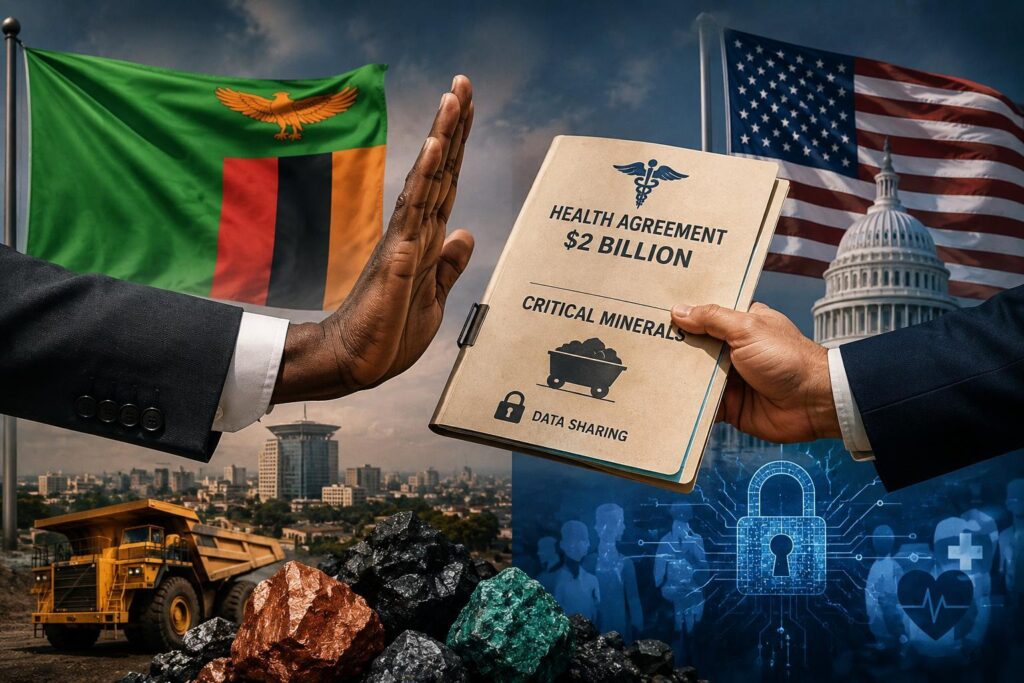
Lusaka, Zambia: The government of Zambia has sparked public controversy after refusing to sign a $2 billion healthcare deal with the US. Citing “unacceptable terms,” Lusaka pointed to demands for exclusive mineral-extraction privileges for US corporations and extensive biometric sharing.
In response to the situation, Thabo Kawana, Permanent Secretary at the Ministry of Information and Media in Zambia, emphasised that the country needed to move beyond aid-based relationships and negotiate equal partnerships grounded in Zambia’s considerable natural resources.
“Today’s Africa isn’t where you go to receive aid,” Kawana said. “Today’s Africa is where you go to partner. Where you recognise that the minerals and resources that we have will contribute not only to Africa’s development, but to the development outside of Africa.”
Yusuf Dodi, an economist, noted that Zambia is the second-largest copper producer in Africa, emphasising that the need for mineral resources for renewable technologies positions Zambia well. “We hold all the cards. We have the power to set the agenda.”
Zambia produced 890,346 metric tonnes of copper in 2025, while the government has set targets to reach 1 million metric tonnes in 2026 and 3 million metric tonnes annually until 2031.
Despite acknowledging the need to switch to internal supply sources, Masiku Phiri, president of the Medical Association of Zambia, emphasised the importance of external support in the healthcare industry and advised a gradual withdrawal.
A similar proposal was previously declined in Zimbabwe and Ghana for privacy reasons, and halted in Kenya following judicial intervention. Former US ambassador Michael Gonzales has denied the claims, labelling them “patently false”.
View the full video report below
[This current affairs report item is provided as part of Broadcast Media Africa (BMA)’s mandate to keep Africa’s broadcast media audiences and stakeholders informed on international developments in local and global humanitarian and public service broadcasting.]