







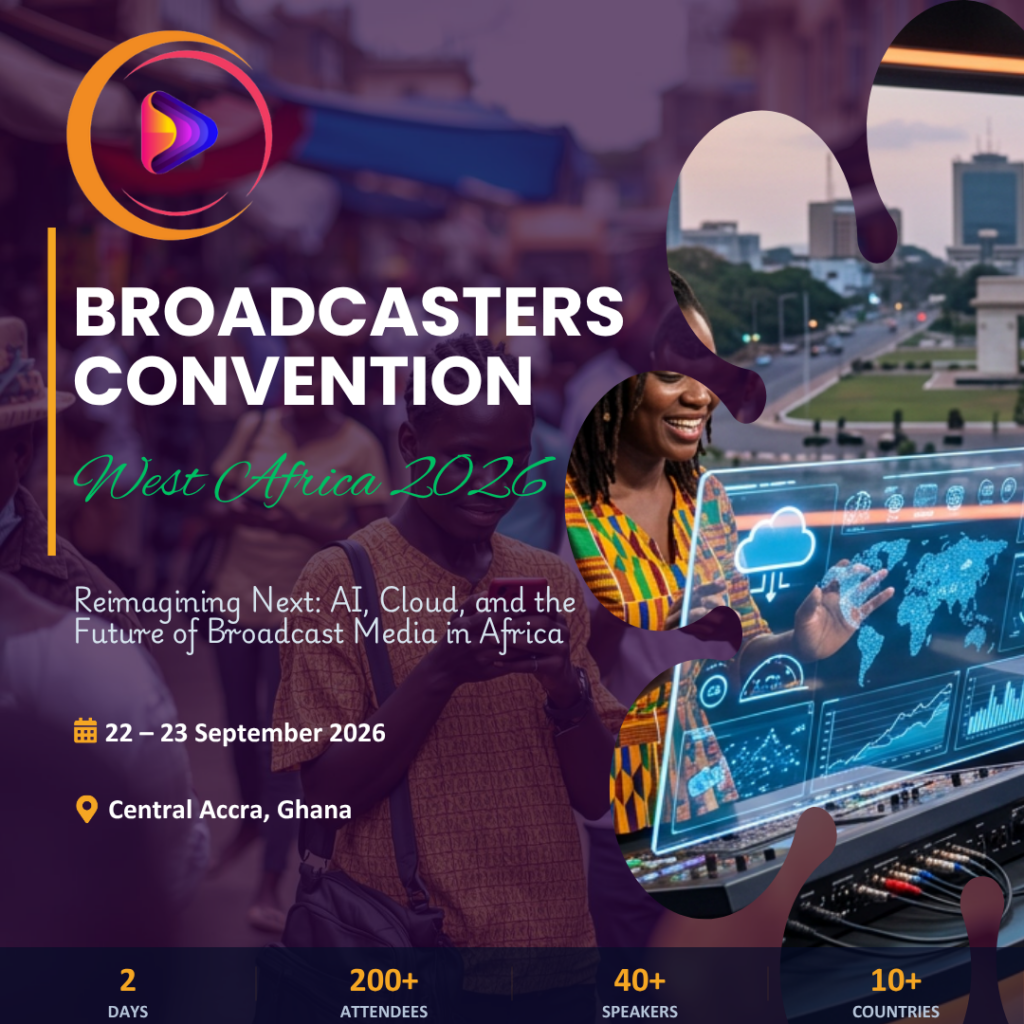
The Broadcasters Convention – West Africa 2026 officially opened in Accra yesterday, 22 September 2026, bringing together broadcasters, media executives, technology providers, regulators and content professionals from across West Africa and beyond to examine the forces reshaping the continent’s media industry.
Convened by Broadcast Media Africa (BMA) and hosted by the Ghana Broadcasting Corporation (GBC), the two-day convention is examining the future of broadcasting through discussions on artificial intelligence, cloud technologies, digital transformation, content innovation, audience engagement, regulation and new business models.
Opening the convention, Benjamin Pius, CEO of Broadcast Media Africa, joined Professor Amin Alhassan, Director General of GBC, and Deputy Minister of Government Communications Shamima Muslim to set the tone for discussions on the opportunities and challenges confronting African broadcasters.
A central message emerging from Day 1 was the need for African broadcasters to move beyond being consumers of technologies developed elsewhere and instead play a more active role in shaping the continent’s media future.
Discussions highlighted the need for broadcasters to better understand their audiences, clearly define their distinctive value and develop stronger strategies for retaining audience attention in an increasingly fragmented media environment.
The convention also examined the growing role of artificial intelligence across the broadcasting ecosystem. A panel on accelerating AI adoption in African newsrooms explored practical applications of AI, the need for skills development, cybersecurity risks, responsible AI governance and the importance of collaboration between broadcasters, technology companies, regulators and continental institutions.
Representatives from the African Union of Broadcasting, MTN Ghana, and Ghana’s National Media Commission discussed how AI, digital infrastructure, and smarter regulatory approaches can support innovation while protecting content quality, public trust, and audiences.
Cloud broadcasting was another major focus of Day 1. Theodore Asampong, CEO of West Africa Platform Services, examined how cloud technologies can help broadcasters re-architect production and distribution environments without owning extensive physical infrastructure.
The discussions also highlighted the importance of locally hosted cloud infrastructure for African broadcasters, particularly in addressing connectivity, affordability and data sovereignty challenges. A hybrid approach combining local cloud infrastructure with satellite distribution was presented as one potential model for improving reliability and reach across the region.
Audience behaviour and engagement also came under close examination. With audiences increasingly consuming content across traditional broadcast channels, social media and other digital platforms, speakers stressed that broadcasters need to move beyond conventional reach measurements and develop a deeper understanding of audience behaviour, preferences and engagement.
The challenge of taking African content to global audiences was another key discussion. Panellists emphasised that African stories do not necessarily need to lose their authenticity to reach international audiences. Instead, they said more attention is needed to production quality, marketing, distribution and commercialisation from the earliest stages of content development.
The convention also explored the wider challenges facing Africa’s creative and media industries, including access to finance, regulation, ownership of creative rights, data ownership, infrastructure and sustainable business models.
Max Jarrett of the African Development Bank highlighted the potential role of blended finance vehicles in scaling investment in Africa’s media and creative sectors. Discussions on tokenisation also examined its potential application to creative rights and revenue generation, alongside the need for appropriate regulation and a better understanding of emerging technologies.
A recurring message throughout Day 1 was the importance of collaboration. Participants called for stronger cooperation between broadcasters, regulators, technology companies, content creators and investors to develop African media infrastructure, strengthen content ecosystems and create sustainable business models.
The convention also featured discussions around a proposed Pan-African media initiative aimed at strengthening Africa’s ability to tell its own stories and improve cross-border awareness. Former President John Dramani Mahama spoke about the need for greater media representation and continental awareness, while discussions around the Africa Public Interest Media Initiative explored how media and technology could help connect African audiences across national borders.
Day 1 concluded with continued conversations around practical collaboration, technology adoption, audience engagement and content development, setting the stage for further discussions on the future of African broadcasting.
As the convention moves into its second day, attention will remain focused on translating the ideas raised during the opening day into practical strategies that can strengthen Africa’s broadcasting and media ecosystem.
The Broadcasters Convention – West Africa 2026 continues today in Accra, bringing together industry leaders and stakeholders to explore how technology, content, innovation and collaboration can shape the next chapter of African broadcasting.
To view highlights for Day 1, click HERE.