







For most of the more than 200 participants from 46 African countries, the Russia-Africa Media Forum was a week of events, sessions and panels. For Peter Denk, Head of News at the Namibia Broadcasting Corporation (NBC), it was also the end of a negotiation. When the forum closed, RT listed NBC among the African organisations it had signed agreements with, alongside the public broadcasters of Ghana, Tanzania and Zimbabwe.
That agreement between RT and NBC had been months in the making. In March, NBC management met representatives of RT Africa in Windhoek to discuss a memorandum of understanding. NBC’s Director General, said the two organisations should cooperate on training, content sharing and co-production, and that NBC was looking at how RT could get a slot on its NBC Plus platform. “A great deal of our leadership actually found their feet somewhere in Russia as well,” he said. The head of RT Africa offered training through RT’s online platform, including “at least an online workshop dedicated solely to Namibia”.
Denk said much the same in Moscow, speaking to RT on 27 October. “There’s so much that we have in common with Russia,” he said. “Russia has inspired social struggles, the liberation struggle of Namibia, for instance. So many of our leaders have come to train here and have gotten their education here.” That shared history, he argued, is what brings broadcasters “together at forums like this, because we all know what the mainstream, so-called mainstream media is telling us about what Russia is. But when you come here, you have a different story”
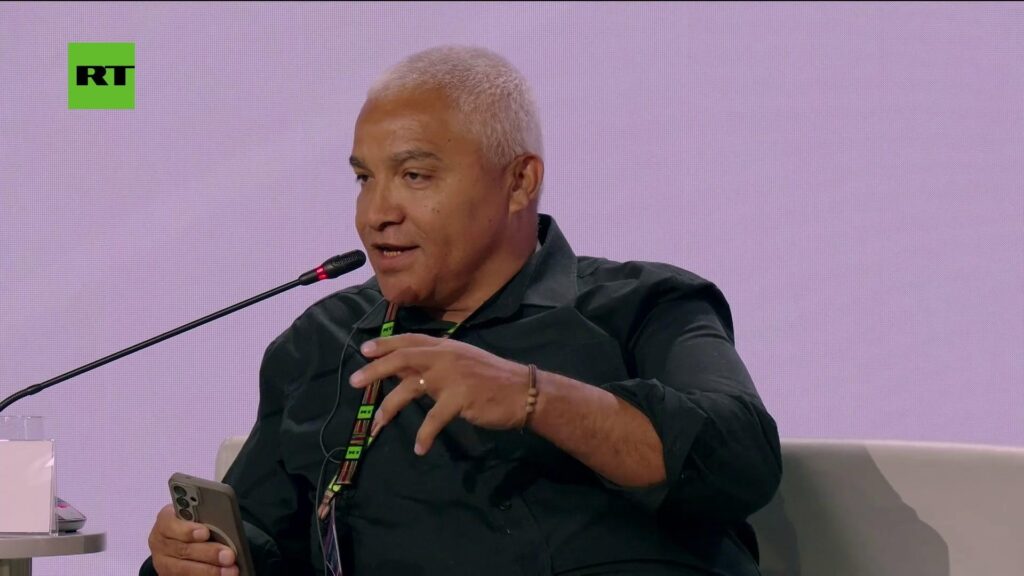
Peter Denk on the “Africa must unite” vs “Africa is not a country” panel, Russia-Africa Media Forum, Moscow, 26 October 2026. Still: RT footage
What he takes back to Windhoek
Denk said he would take one lesson home: “find the correct narrative!
For a head of news, “the correct narrative” is a demanding standard. On the forum’s opening panel, Denk asked for room “to harness the diversity of content”. He cited a 2024 study by Africa No Filter and the University of Cape Town, which found that international coverage of Africa was dominated by conflict, poverty, disease and political instability. He offered Namibia’s own story, independence in 1990 and the peaceful transition that followed, as the kind of news that deserves more airtime
What he valued most was the tone of the exchange. “There’s no arrogance, there’s always mutual respect,” he said. “I think that is the basis of my experience here”
The test at the desk
That leaves the test where Denk’s own advice places it: in the newsroom.
Training and content sharing can widen what a desk knows about the world. Whether they also change what it believes depends on Windhoek editors applying the rule Denk brought home from Moscow, and not always following what they are told, whoever is doing the telling.
Watch Video, Part 3: The newsroom view
Tomorrow, Part 4: Creators. The YouTubers and digital storytellers who came to Moscow to tell Africa’s story their own way.

