







Journalists are still at the heart of the newsroom, but the tools they use are changing. AI is taking on many of the routine tasks, from transcribing interviews and translating content to helping reporters uncover new angles and story ideas more quickly.
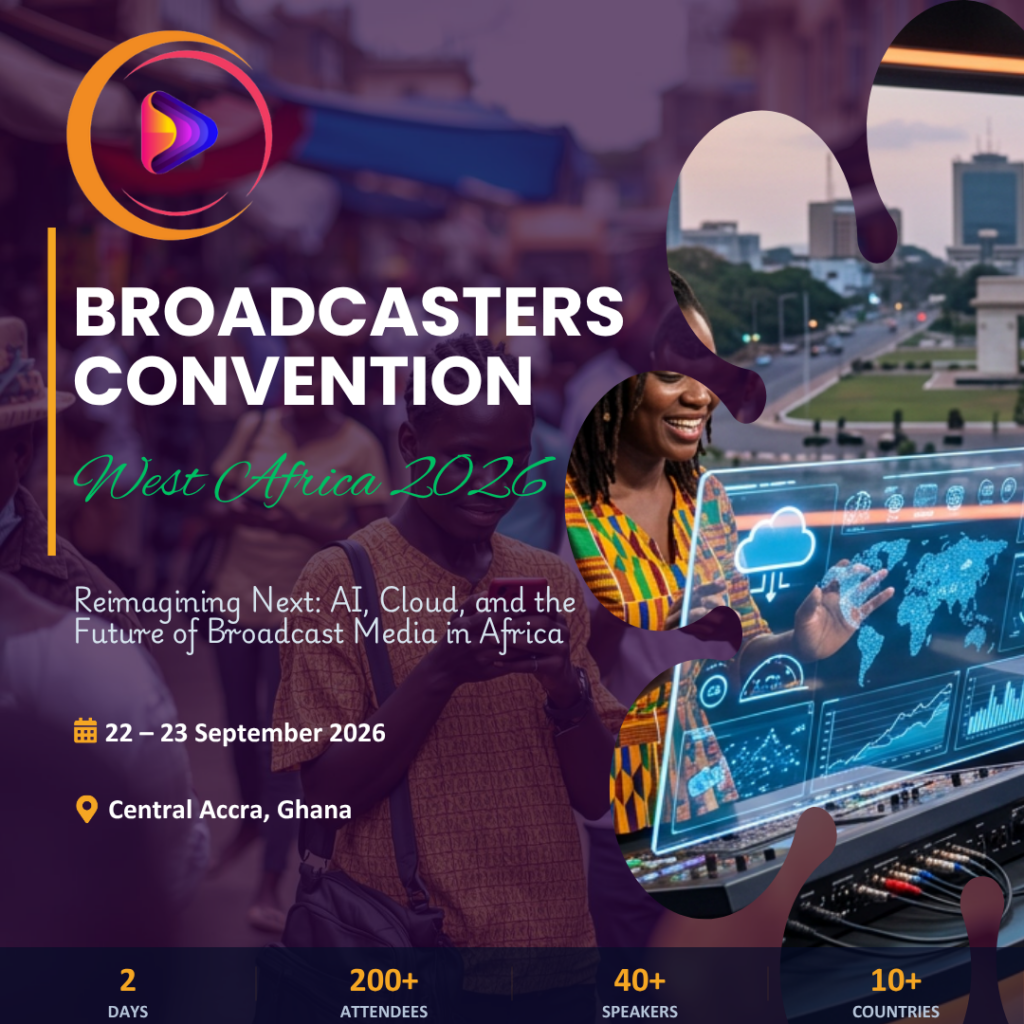
It’s a conversation that will be front and centre at the Broadcasters Convention West Africa 2026, taking place from 22 to 23 September 2026 at the Labadi Beach Hotel in Accra, Ghana, where editors, publishers and media executives from across the region will gather to unpack exactly this tension between innovation and trust.
Most news organisations have spent years earning their reputation. It came from getting stories right, correcting them when they were wrong, and protecting sources, even when it wasn’t easy. AI is now becoming another newsroom tool, but many editors are still working out how to use it without compromising the standards that earned that trust in the first place.
AI can quickly scan through bulk documents, identify patterns that may go unnoticed by human eyes, translate content for various audiences, and handle repetitive tasks that burden journalists. In numerous African newsrooms, where resources are limited and teams are small, this will help organisations achieve greater output with fewer resources.
There are risks attached, because the same technology that helps journalists work more efficiently can also be used to spread false information. AI can generate realistic quotes, alter images, and produce convincing videos in a matter of seconds. By the time that content begins circulating on social media, it has often reached thousands of people before anyone has a chance to set the record straight.
This is where the next-generation newsroom has to be deliberate. It’s not enough to bolt AI onto old processes and hope for the best. Newsrooms need clear editorial guardrails: humans verifying anything AI touches before it reaches an audience, transparent labelling when AI has been used in production, and ongoing training so journalists understand both the power and the limits of the tools they’re using.
There’s also a bigger, industry-wide responsibility here. Misinformation doesn’t respect borders, and neither should the fight against it. Broadcasters, regulators, tech platforms and fact-checking organisations all have a role to play in building a media ecosystem where audiences can tell the difference between what’s real and what’s manufactured.
Speaking on the subject, Benjamin Pius, CEO and Publisher of Broadcast Media Africa (BMA), shared his perspective on what’s at stake for the continent’s media industry:
“AI is not the enemy of trust; carelessness is. If we deploy these tools with the same rigour we’ve always applied to good journalism, AI can actually strengthen the newsroom rather than weaken it. But that requires intention. African newsrooms cannot afford to be passive adopters of this technology. We need to be active shapers of how it’s used, because the cost of getting this wrong isn’t just a bad headline; it’s the erosion of public trust in media altogether, at a time when that trust is already fragile.”
The next-generation newsroom isn’t fully automated. It’s one where AI handles the heavy lifting, and human editors remain firmly in charge of the truth. Getting that balance right may be one of the most important tasks facing African media today, not because the technology demands it, but because the audience does.
To register and get more info about the convention, please check HERE.