





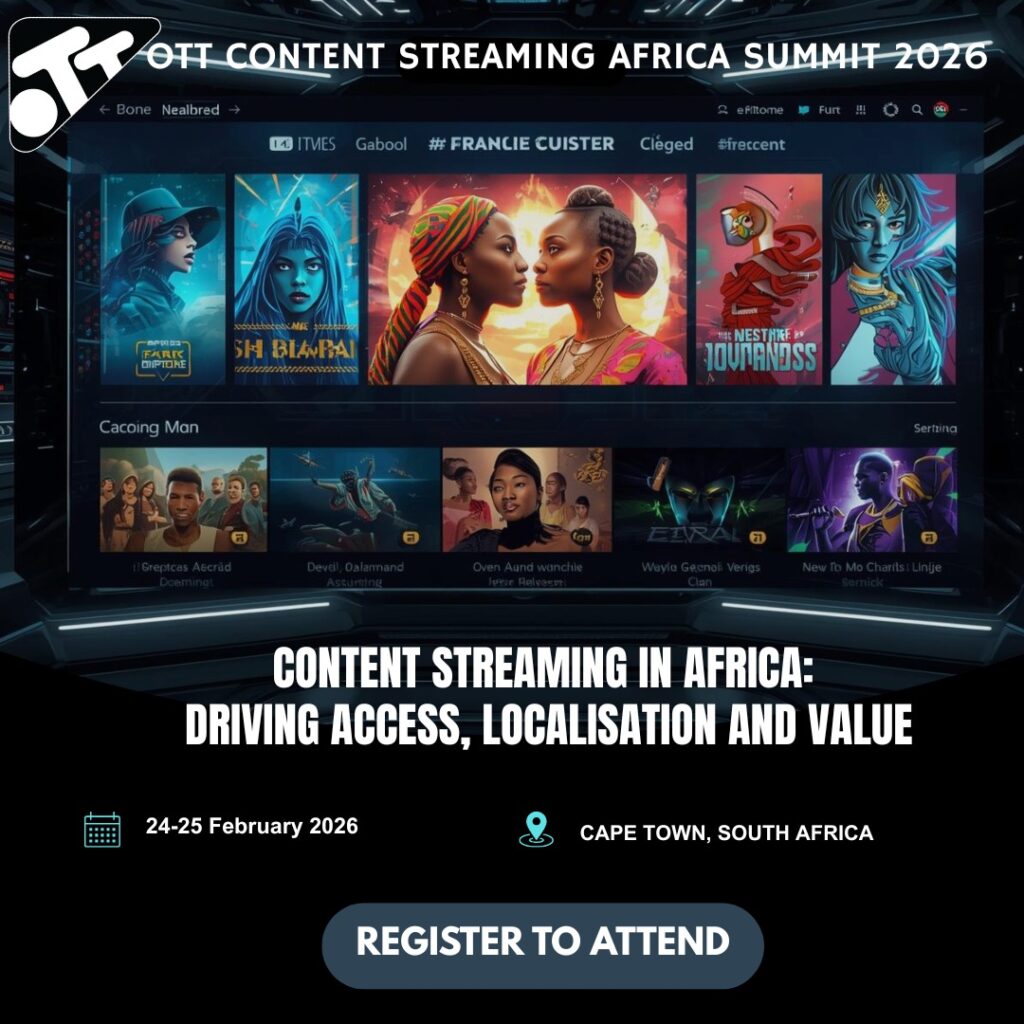
[This article is written by Benjamin Pius (Publisher @ BMA) as part of the forthcoming OTT-Streaming Africa Summit 2026, 24–25 February, Cape Town. Learn more about the event here]
Not long ago, the narrative of African media was disruption and displacement—global OTT giants starving traditional broadcasters while telcos remained passive “dumb pipes.” That narrative has flipped.
Today, every industry stakeholder surveyed by BMA agrees that Africa’s streaming future depends on structural collaboration alongside competition. The question is no longer who wins, but how broadcasters, telcos, and OTT platforms co-exist to unlock a market projected to reach 15 million SVOD subscribers this year.
African broadcasters, it turns out, hold advantages global players cannot easily replicate. They command home-ground through hyper-local content—telenovelas, reality formats, and live sports rooted in African languages and lived experience. More critically, by controlling their content outright, they can distribute programming across linear, OTT, and FAST channels without third-party constraints, creating long-tail revenue through syndication, licensing, and format sales that traditional arrangements never permitted.
Telcos, meanwhile, have repositioned themselves at the centre of the value chain. Bundling streaming with data plans will account for 23% of global SVOD subscriptions by 2030, and in Africa—where credit card penetration remains low—it is often the only viable payment pathway.
The telco that controls the bundle controls the customer. Those investing in network quality gain an even greater advantage: MTN Nigeria leads with 67% streaming performance, making it the preferred carrier for video consumption.
The clearest signal of this new cooperation is “super-aggregation”—bundling multiple streaming services under one account. In July 2025, Canal+ became the first operator to distribute Netflix across 24 Francophone African countries, giving Netflix access to 8.2 million subscribers while reinforcing Canal+ as Africa’s premier aggregator. Former rivals now share the same interface.
What emerges is a hybrid future. The industry is converging on a “Linear plus OTT plus FAST” model where traditional television does not die but evolves into a cornerstone of broader networks. FAST channels grew 21% globally in 2025, extending their reach to 68% of Africans who are not yet paying for streaming.
The true expertise in 2026 lies in executing these localised strategies, and these will be the focus of the OTT-Streaming Africa Summit 2026, hosted by the SABC+ and convened by Broadcast Media Africa. Because in a market this dynamic, structural cooperation is not a compromise—it is a competitive advantage.
[This article is written by Benjamin Pius (Publisher @ BMA) as part of the forthcoming OTT-Streaming Africa Summit 2026, 24–25 February, Cape Town. Learn more about the event here]