







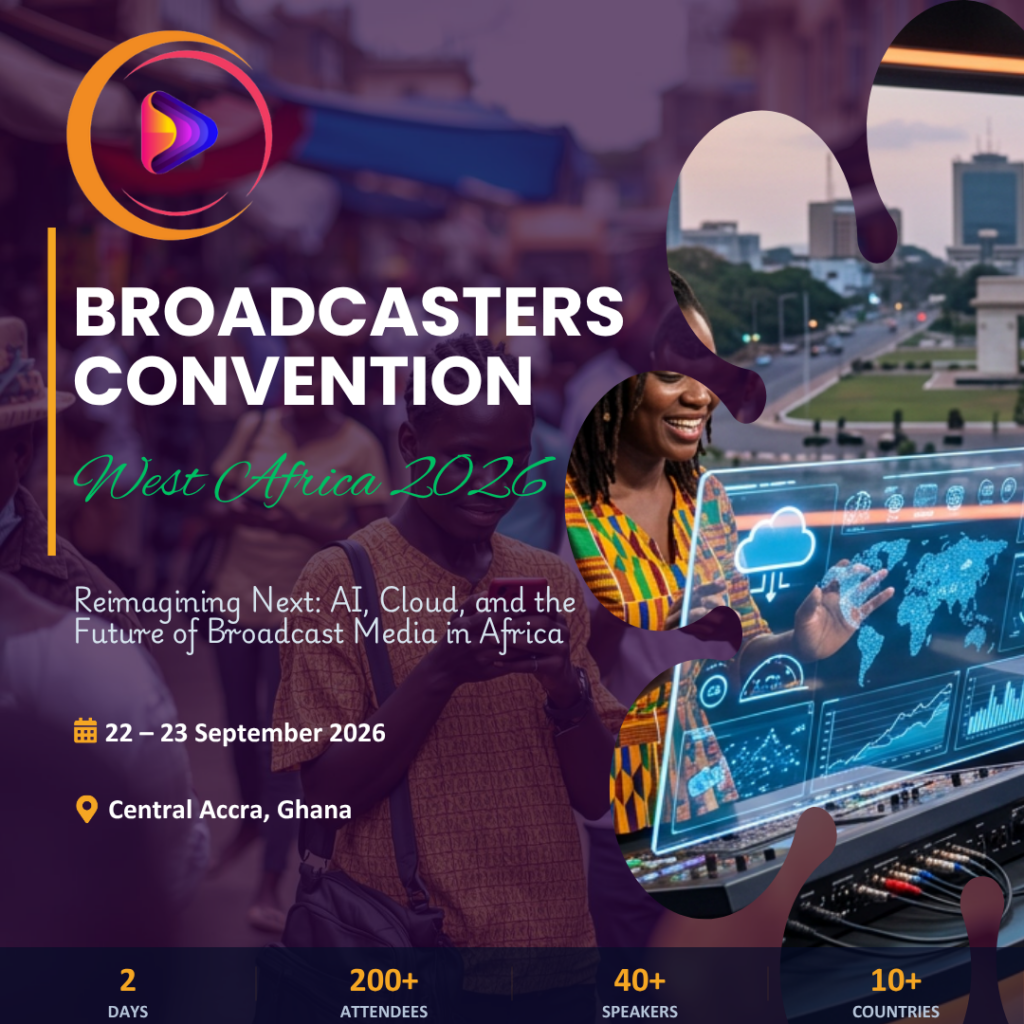
The West Africa Broadcasters Convention 2026 has concluded with a strong call for African broadcasters and media stakeholders to collaborate more closely, invest in people and technology, and develop new business models to remain sustainable and relevant in a rapidly changing media environment.
The convention, convened by Broadcast Media Africa (BMA), brought together broadcasters, media executives, technology companies, regulators, content creators and industry experts to examine the future of broadcasting across the continent, with discussions spanning artificial intelligence, digital migration, spectrum, content distribution, monetisation, audience measurement, podcasting and the media’s role in Africa’s development.
From AI-powered newsrooms and digital migration to streaming, podcasting and audience monetisation, discussions highlighted both the scale of the transformation underway and the need for broadcasters to turn emerging opportunities into practical action.
Artificial intelligence featured prominently, with industry experts examining how AI is already being used for research, translation, data analysis and content production.
While AI can improve newsroom speed and efficiency, speakers stressed that human oversight remains critical to accuracy, verification and audience trust.
The message was clear: broadcasters need to embrace AI while investing in the skills required to use it responsibly and effectively.
Dr Yemisi Bamgbose, the Executive Secretary of BON, highlighted the resilience of African broadcasting while pointing to ongoing challenges around digital migration, spectrum allocation, infrastructure costs, and technical skills.
Participants called for stronger collaboration between broadcasters, regulators and governments, particularly on spectrum policy and reinvesting resources in broadcasting infrastructure and skills development.
The convention also explored how broadcasters can reach and monetise audiences across an increasingly fragmented media environment.
Presentations from Sputnik Africa, RT Africa, MTN and SES Media highlighted the growing importance of hybrid distribution models combining satellite, IP, mobile and streaming.
Discussions around AVOD, SVOD, TVOD, branded content, content licensing, events and activations reinforced the need for broadcasters to diversify beyond traditional advertising.
Audience data and independent measurement were also identified as critical to improving advertising value and understanding changing consumption patterns.
Radio remains one of Africa’s most accessible and trusted media platforms, but speakers urged broadcasters to embrace podcasting and audio-on-demand as complementary opportunities.
The industry was encouraged to use digital audio to deepen audience engagement, reach specialised communities and develop additional revenue streams.
The convention also looked beyond technology and commercial sustainability.
Nana Sewa Sapong challenged media organisations to make Africa’s development story more accessible by connecting the Sustainable Development Goals (SDGs) with everyday realities and amplifying African perspectives.
Across the convention, one message stood out: African broadcasters cannot navigate this transformation alone.
Greater collaboration, knowledge sharing, investment in people and stronger engagement between broadcasters, regulators, technology companies and content creators will be essential to building a sustainable future for the industry.
Benjamin Pius, CEO of Broadcast Media Africa, said, “The future of African broadcasting will depend on how effectively we collaborate, invest in our people and respond to changing audience behaviour. These challenges require an industry-wide approach.”
The West Africa Broadcasters Convention 2026 ultimately reinforced the need for African broadcasting to move beyond adapting to change and towards actively shaping its future — through innovation, collaboration, investment in people and a deeper understanding of the audiences it serves.


