







Can a broadcaster that still thinks of itself primarily as a channel survive as a business? What happens to newsroom credibility when the production cycle never stops, but the verification budget never grows? Why does so much African content sit on servers in a form nobody can properly search, sell or licence?
And can you win a battle for attention you cannot even see, when audience measurement still leans heavily on methods built for one screen, one schedule and one household television or radio set?
These are uncomfortable questions, but perhaps broadcasting in Africa has reached the point where uncomfortable questions are more useful than another conversation about “transformation”.
We all know the routine. We arrive at a convention, describe our transformation plans in confident language, collect applause and go home. A year later, we turn up at the next one and describe roughly the same plans again, in slightly newer language. Nobody checks until now.
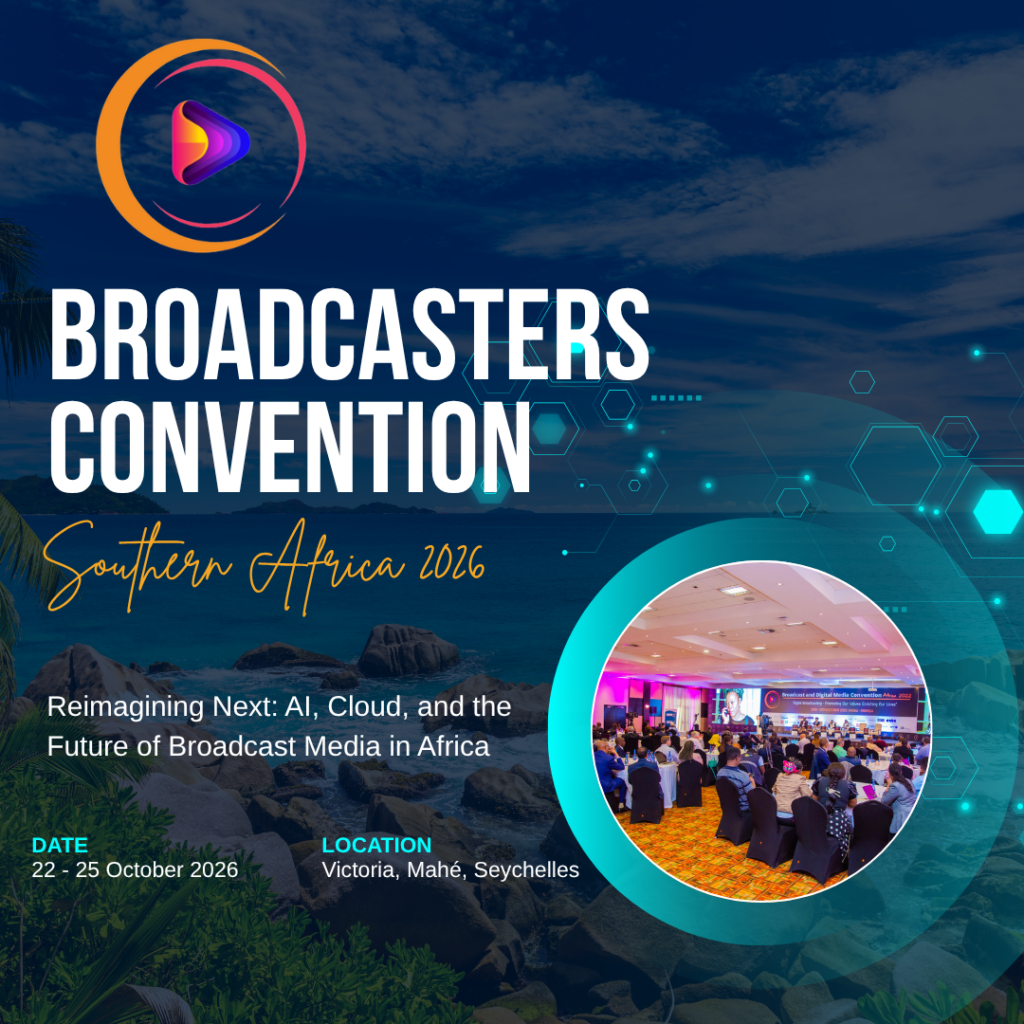
The announced programme for the Broadcasters Convention – Southern Africa 2026, taking place in Victoria, Mahé, Seychelles, from 22–25 October, breaks that arrangement. Not through the keynote and not through anything in the opening ceremony. But through the session sitting right at the end of the entire programme: the SABA Member Country Reports – 12 Months Since Victoria Falls, Zimbabwe.
Now, this may turn out to be one of the most revealing sessions of the entire Convention. Because this is when thirteen national broadcasters, from Angola through to Zimbabwe, will stand up in the same room and say what has actually moved on AI, cloud and digital modernisation since the association last met.
Not what is planned. Not what is being considered. Not what sits somewhere in a strategy document. What has actually moved. Now, that is the scoreboard to look forward to.
And this is what makes the Broadcasters Convention in Seychelles potentially very interesting. The important discussion is no longer simply what comes next. It is increasingly what have you actually done with what came before?
The industry is dealing simultaneously with fractured audiences, changing advertising economics, ageing infrastructure, new distribution models, cloud migration, AI, content discoverability, piracy and a newsroom environment in which speed is increasingly cheap but trust remains expensive.
None of those problems will be solved by another declaration that broadcasters must “embrace digital transformation”.
The harder conversation is about execution: what to modernise first, what to stop doing, where the money comes from, what success should be measured against and, ultimately, whether the broadcaster emerging at the other end is actually a stronger business.
The agenda in Seychelles has been built around that gap, and it ends by asking thirteen broadcasters to account for their side of it.
Good way to run a convention.
Slightly nerve-racking too.
Which is rather the point.
This article is written by Benjamin Pius (Publisher @ BMA) ahead of the Broadcasters Convention – Southern Africa 2026, 22–25 October 2026, Victoria, Mahé, the Seychelles.
Hosted by the Seychelles Broadcasting Corporation and convened by Broadcast Media Africa with the Southern Africa Broadcasting Association.