







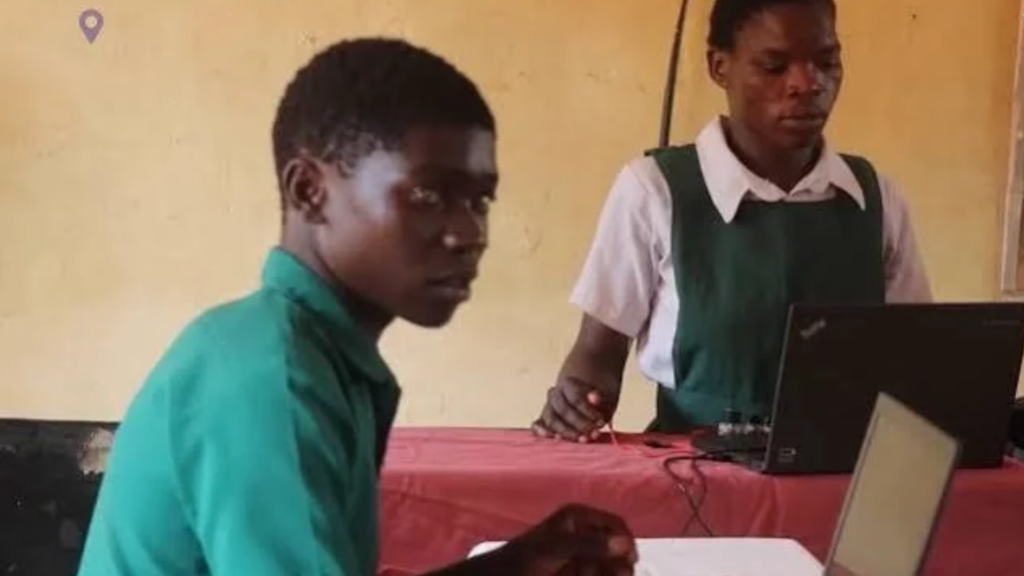
LILONGWE, Malawi – A 25-year-old innovator is transforming education for blind and visually impaired students across Malawi through a voice-controlled artificial intelligence platform. Created by Staff Nyoni of Access Ability Africa, the “Blind Classroom” system lets learners navigate lessons and ask questions with simple voice commands and tactile controllers, crucially, without an internet connection.
Across Malawi, visually impaired students often face severe shortages of specialist teachers, Braille textbooks, and assistive equipment. Piloted at 14 schools, including the Malingunde Resource Centre for the Blind in Lilongwe, Nyoni’s award-winning technology reads study materials aloud, working alongside traditional Braille machines and writing boards to help learners study independently.
The impact in the classroom has been immediate. “Before the Blind Classroom, I used to take position 22, but now my performance has improved, and I am getting position 5 in class,” said student Sphiwe Lonex.
Educators have seen a dramatic shift in exam results. “Earlier, learners would get maybe 20 per cent or 30 per cent, but today learners are getting 70 per cent, 75 per cent and even 90 per cent,” noted teacher Christopher Kika.
Having already reached roughly 700 learners, Nyoni views the system as a vital tool for under-resourced schools. “Not many teachers are specialised to teach these learners,” Nyoni explained. “The Blind Classroom is coming in to bridge this gap.” While currently relying on refurbished laptops to stretch tight budgets, the initiative aims to secure further funding to supply new equipment and expand nationwide.
View the full video report below
[This current affairs report item is provided as part of Broadcast Media Africa (BMA)’s mandate to keep Africa’s broadcast media audiences and stakeholders informed on international developments in local and global humanitarian and public service broadcasting.]

