





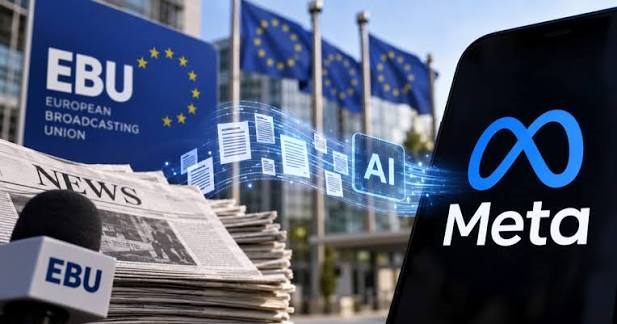
The European Broadcasting Union (EBU) has called on Meta to revise its updated commercial terms, warning that provisions governing automated access to websites linked to business accounts could expose broadcasters’ content to broader use without sufficiently clear consent or a meaningful opt-out.
In a statement issued on 27 October, the EBU said almost all its public service media members use Meta business accounts to manage their presence on Facebook and Instagram. Under the disputed terms, Meta and its automated agents could access content on websites associated with those accounts. The union argues that this creates a significant rights-management problem for broadcasters whose websites contain not only their own journalism and programming, but also third-party sports footage, music, photographs and agency material that they may not have permission to license for other uses.
The union is seeking four protections: separating access to a business account from permission to use website content; restricting any authorisation to material the account holder actually owns; excluding AI training and development unless expressly authorised; and making machine-readable instructions such as robots.txt binding contractual commitments. Richard Burnley, the EBU’s legal and policy director, said Meta should revise the terms and provide a meaningful, non-retaliatory way to opt out without requiring organisations to abandon its platforms.
The dispute has already prompted changes to Meta’s proposed terms. The company removed explicit references to AI training and narrowed the stated purposes for crawling to advertising and business products. However, the EBU argues that these revisions do not resolve the underlying concerns, particularly because its interpretation of robots.txt remains a public assurance rather than an explicit contractual protection.
The implementation date has also shifted. Initially scheduled for 30 October 2026, the revised terms have been postponed until 20 November 2026, according to reporting by The Verge and Nieman Journalism Lab. Meta says the additional time will allow it to explain the changes and clarify how its web crawlers operate.
The EBU contends that the provisions raise questions under the EU’s Digital Single Market Copyright Directive, Article 102 of the Treaty on the Functioning of the European Union and the Digital Markets Act. These are legal concerns advanced by the union, not findings that Meta has breached those rules. European Commission and UK Competition and Markets Authority scrutiny adds to the pressure for clarification.
For African broadcasters, the dispute highlights a wider strategic vulnerability. Facebook and Instagram are important channels for audience reach, content promotion and referral traffic across many African markets. Yet the regulatory frameworks and enforcement mechanisms available in Europe do not apply uniformly across the continent, and local copyright protections vary by jurisdiction.
The practical lesson is that broadcasters should understand the terms attached to their business accounts, audit the rights they hold over material published on linked websites, and review crawler controls and content-licensing arrangements. The EBU’s challenge also raises a broader industry question: how much control can media organisations retain over their intellectual property when access to audiences increasingly depends on privately controlled digital platforms?