






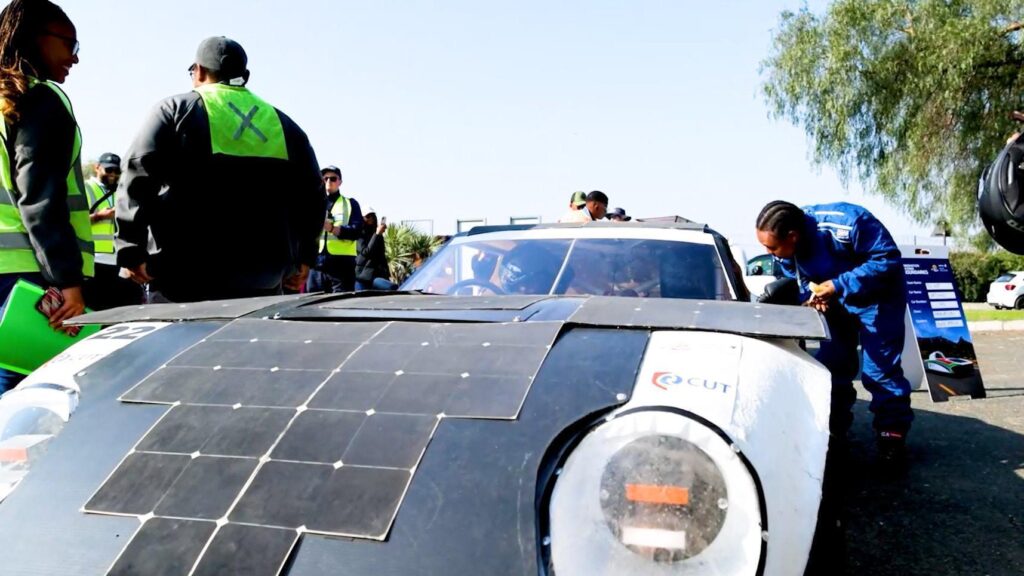
JOHANNESBURG, South Africa – Young engineers and university teams have travelled from Johannesburg to Cape Town in unique solar-powered vehicles as part of the 2026 Sasol Solar Challenge.
Scheduled for 10 to 17 September, the biannual endurance race will test green technology, focusing on distance covered rather than speed.
“The winner is not the team which comes first, but the team which manages to cover the most kilometres in the process,” stated Event Director Rob Walker. “We give them a minimum number of kilometres to cover each day, and there are optional loops where they can make additional kilometres.”
Technical difficulties and environmental factors are two of the many obstacles teams must face during the competition. Denzel Brits, a mechanical engineering student and one of the drivers for North-West University, noted the importance of topography and weather.
“Just having even a little incline already demands power from the batteries,” Brits commented, stressing that dust, rain, and cloudiness affect solar power charging immensely. To address this problem, the Solar Eagle team at North-West University created a tilting solar panel system that uses GPS coordinates to track and follow the sun.
The race also promotes inclusivity and STEM learning through a special schools’ programme. According to Masheko Mhore, Central University of Technology’s driver: “I am creating a way not only for myself as a female, but for all of us as a race, as African Black people. It is really exciting to be a part of the people who create this way.”
View the full video report below
[This current affairs report item is provided as part of Broadcast Media Africa (BMA)’s mandate to keep Africa’s broadcast media audiences and stakeholders informed on international developments in local and global humanitarian and public service broadcasting.]


