







The media landscape is changing quickly. As digital platforms, streaming services and social media expand, broadcasters and content producers are expected to create more content, in more formats, and deliver it faster. AI is now becoming an important part of that shift, changing how content is created, produced and delivered.
From automatically editing video and converting speech into text to generating subtitles and tagging thousands of hours of archive material, AI is increasingly taking on time-consuming production tasks that have traditionally required significant human effort.
The implications for broadcasters are substantial. AI-assisted production has the potential to reduce turnaround times, improve workflow efficiency, make archives more accessible and allow production teams to repurpose existing content for multiple platforms without having to rebuild the process from the beginning.
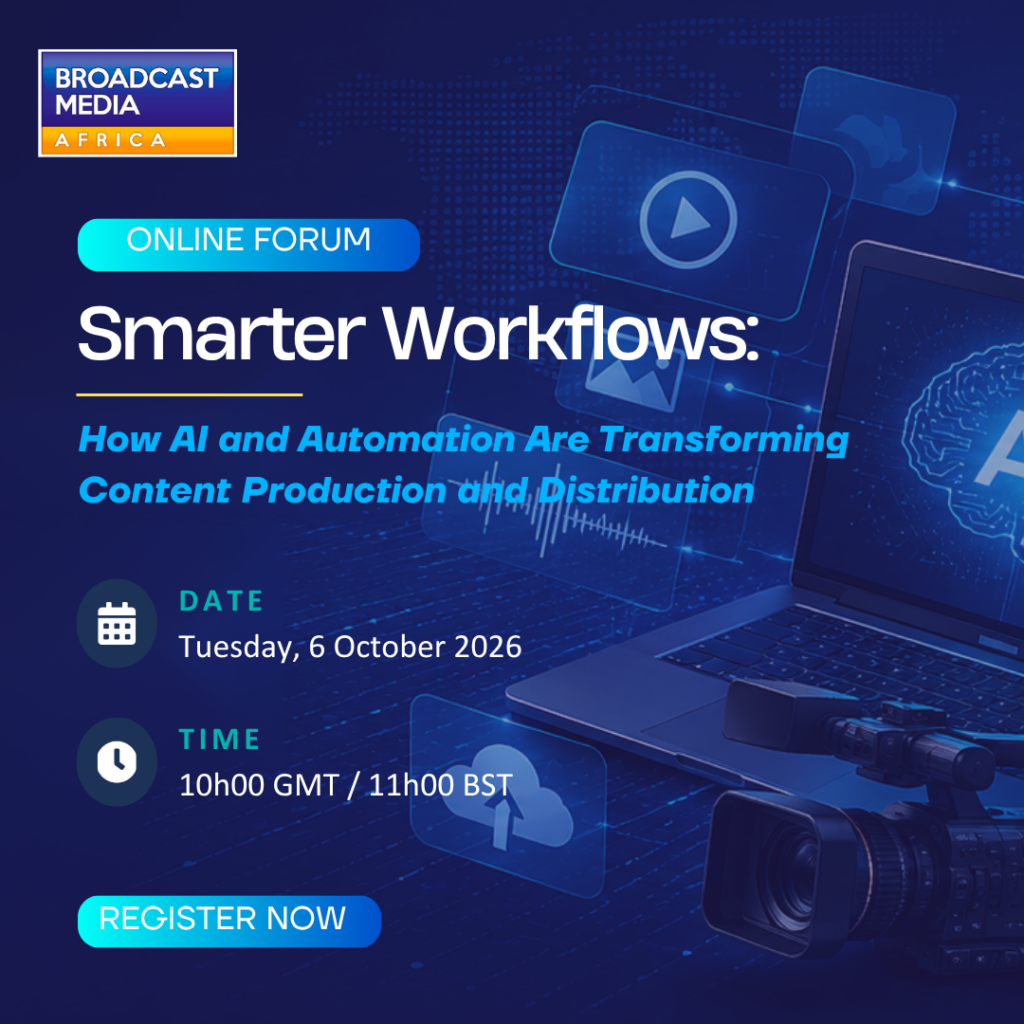
These developments will be explored in depth during the upcoming “Smarter Workflows: How AI and Automation Are Transforming Content Production and Distribution“ webinar, taking place on Tuesday, 06 October 2026, hosted by Broadcast Media Africa (BMA).
Broadcasters have accumulated enormous archives of video, audio and photographic material over decades. Yet finding specific content within these archives can be difficult when metadata is incomplete, inconsistent or reliant on manual cataloguing.
AI can analyse content and automatically identify people, places, subjects, objects, events and other contextual information, creating metadata that makes media libraries easier to search and navigate.
For broadcasters, however, the challenge will be determining where automation delivers genuine value while maintaining editorial standards, creative control, accuracy, copyright compliance and responsible use of technology.
The “Smarter Workflows: How AI and Automation Are Transforming Content Production and Distribution“ webinar will bring together media professionals and technology stakeholders to examine how AI is changing production and distribution processes.
Visit HERE to learn more.