







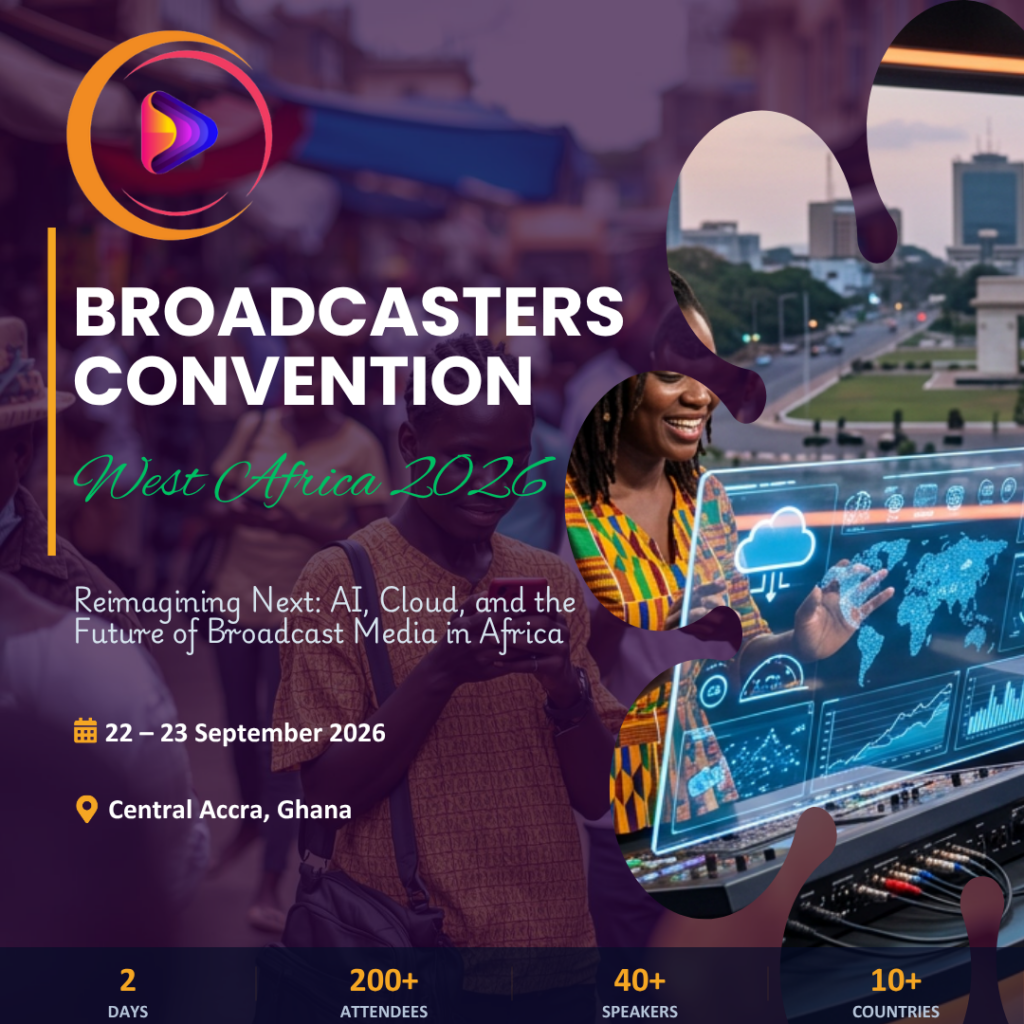
This article is written by Benjamin Pius (Publisher @ BMA) as part of the forthcoming Broadcasters Convention – West Africa 2026, 22–23 September 2026, Labadi Beach Hotel, Accra, Ghana. Go here to visit the event website
For decades, the business of broadcasting in Africa rested on a familiar tripod: linear advertising, government subvention and, for the fortunate few, subscription income. That tripod is wobbling. Audiences have fragmented across OTT platforms, social video and mobile-first services, while advertising spend follows them onto global digital platforms that sit outside the traditional broadcast value chain. The question confronting every boardroom from Accra to Abuja is no longer whether the old model is under pressure — it is what a genuinely sustainable model looks like in its place.
- DIVERSIFIED REVENUES
The first pillar of that new model is revenue diversification. Broadcasters across the region are learning that no single income stream can carry the enterprise. The emerging playbook blends targeted digital advertising, subscription and freemium OTT offerings, FAST channels, branded content, events and the commercial exploitation of archives. Crucially, these are not bolt-ons to a linear core; they are interconnected products of a single content supply chain, managed end-to-end across every platform on which audiences now live.
- INTELLIGENT USE OF AI
The second pillar is artificial intelligence — not as a novelty, but as an economic instrument. AI-powered audience analytics and measurement allow broadcasters to prove value to advertisers with a precision that linear ratings never could, thereby commanding better yields. AI-driven archiving, preservation and retrieval systems turn decades of dormant content into searchable, licensable and monetisable assets. And automated newsroom and production workflows attack the cost side of the ledger, freeing scarce resources for the journalism and storytelling that differentiate a broadcaster in the first place.
The most sustainable asset an African broadcaster owns is its relationship with its audience. Every technology decision should deepen it — never dilute it.
- INFRASTRUCTURAL DISCIPLINE
The third pillar is infrastructure discipline.
Sustainability is as much about cost structure as it is about revenue. Cloud-based operations, hybrid cloud-satellite workflows and next-generation satellite distribution models offer broadcasters scalable, resilient delivery without the capital burden of legacy plant. The broadcasters winning this transition are those converting fixed costs into flexible ones — and reinvesting the difference into content and audience data.
Now, none of this is theoretical. Across Africa, broadcast operators are already experimenting with these models — some succeeding, many learning hard lessons.
What the industry needs now is a candid, senior-level exchange of what is actually working. That is precisely the conversation the Broadcasters Convention – West Africa 2026 will convene in Accra this September, bringing together the region’s broadcast leaders, innovators and technology partners to move sustainability from aspiration to operating reality.
This article is written by Benjamin Pius (Publisher @ BMA) as part of the forthcoming Broadcasters Convention – West Africa 2026, 22–23 September 2026, Labadi Beach Hotel, Accra, Ghana.