







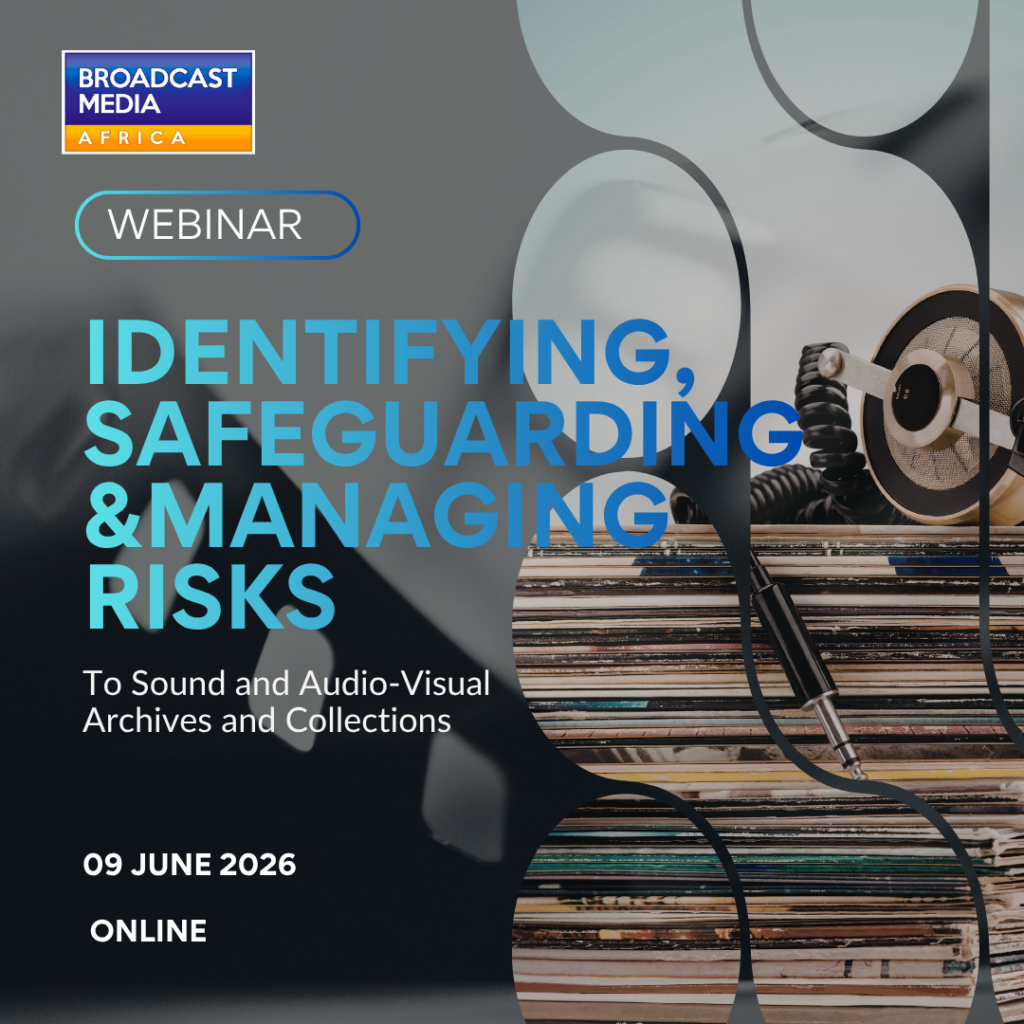
Africa’s audio-visual and sound heritage is under increasing threat from media degradation, climate-related challenges, technological obsolescence, limited resources, and constraints on institutional capacity, according to experts who participated in the webinar, “Identifying, Safeguarding And Managing Risks To Sound And Audio-Visual Archives And Collections,” held on 09 June 2026.
The industry event brought together leading archivists, preservation specialists, broadcasters, and heritage professionals from across Africa and beyond to examine the most critical threats facing archives and collections and to explore practical strategies for safeguarding valuable audio-visual heritage for future generations.
During the discussions, speakers emphasised that many of Africa’s sound and audio-visual collections contain unique historical, cultural, and social records that may exist nowhere else. The loss of these archives would represent an irreversible loss of collective memory and heritage.
Participants identified three broad categories of risk currently affecting archives and collections:
- Physical risks, including media degradation, environmental damage, and obsolete playback equipment.
- Digital risks, including poor discoverability, inadequate metadata, and challenges associated with managing digitised content.
- Institutional risks, such as limited funding, skills shortages, and the absence of long-term preservation planning.
The webinar highlighted the growing impact of climate change and environmental conditions on archival collections. Experts noted that rising temperatures, fluctuating humidity, flooding, and extreme weather events are accelerating the deterioration of both analogue and digital materials, creating new preservation challenges for institutions across the continent.
A recurring theme throughout the discussions was the urgent need to digitise at-risk collections before specialised playback equipment and technical expertise become unavailable. Participants warned that many legacy audio and video formats are approaching a critical point at which preservation opportunities may be permanently lost if action is delayed.
The panel also stressed that risk assessment should not be viewed as a one-time exercise but rather as a continuous process integrated into collection management, preservation planning, acquisition strategies, cataloguing, access workflows, and organisational decision-making.
Experts recommended that institutions adopt practical risk assessment methodologies, including collection surveys, risk matrices, metadata audits, and prioritisation frameworks that enable organisations to identify the most vulnerable and most valuable materials. Such approaches allow archives to maximise limited resources while reducing the likelihood of irreversible losses.
Another key conclusion was the importance of collaboration and partnerships in strengthening archive preservation efforts. Participants noted that no institution can effectively address preservation challenges in isolation, and that partnerships among broadcasters, archives, governments, technology providers, academic institutions, and international organisations will be essential to building sustainable preservation capacity across Africa.
Speaking during the webinar, participants emphasised that safeguarding audio-visual heritage is not simply a technical responsibility but a strategic imperative that protects cultural identity, supports research and education, and ensures future generations can access and engage with Africa’s rich historical record.
The webinar concluded with a strong call for African institutions to accelerate preservation initiatives, strengthen risk management practices, invest in skills development, and foster collaborative partnerships to secure the continent’s audio-visual and sound archives for the future.
To view the webinar summary, please click here.